Showing posts with label K-pop. Show all posts

Monday, April 23, 2018

In the Garden of Life: Rhizomes


It's finally spring!

Anyone who knows me, knows I love the outdoors. Plants, animals, soils, water, winds, clouds: I love to explore and wonder at things big and small. I love just sitting and taking in all the details that make up an environment.

This week, I came across something that ties that interest with another of my passions: philosophy. 

The idea behind it was not new to me; I’ve been talking about and working with the effects of this idea for quite a long time. It’s just that now I have an official term for it: rhizome theory. Humanity can develop like ginger or irises: horizontally, spreading outward in any number of ways and directions. And like these plants, sections can be cut and moved elsewhere to continue developing in other environments that result in newer evolutions.

I read Mark Gartler’s review of the subject on The Chicago School of Media Theory’s website to gain a better understanding. The rhizome theory was hinted at by Swiss psychiatrist Carl Jung but developed by French philosopher Gilles Deleuze and clinical psychoanalyst FĂ©lix Guattari in the second half of the 20th century. It contrasts with the more traditional Western thought pattern that things (biology, government, art, etc) develop sequentially, in a tree-like format. A tree leads one to visualize 2 options: yes/no, plus/minus, on/off.

The tree model emphasizes a hierarchy, like a triangle, with only a few things/people on top, and that apex is considered vital to the survival of the whole. 

What if the system is turned on its side? What if ideas/information/power/money/choices are generated by any number of beginnings and shared across groups? An example is the World Wide Web.
Violets spread by rhizomes

“Unlike the tree, whose branches have all grown from a single trunk, the rhizome has no unique source from which all development occurs. The rhizome is both heterogeneous and multiplicitous.” - Mark Gartler

In a totally uninhibited WWW, things flow like rhizomes, but not to the exclusion of trees. Even the web, as Mr. Gartler’s paper notes, is actually structured like a tree: each section of a web address, separated by “/”, is a branch from the previous trunk. When some want to manipulate the web, those individuals are attempting to establish trees, with themselves as the trunk. Trees can be extremely efficient structures. However, if that main trunk’s intentions are tainted by greed or with the intention to manipulate, they will give rise to destructive entities. We’ve already seen that happen with the creation of fake sites and users whose sole purpose is to deceive and influence with no hard facts. In these cases, the scattered nature of rhizomes protects them somewhat from the domination of malicious trees. The rhizome’s weakness? That spreading can choke the ground with too much competition.

My own best experience with rhizome theory comes from a third passion of mine: K-Pop. 

I’ve written before (in Life and Fandom and Change of Pace) about my amazement at the ability of fans to come together in groups to define goals, establish plans and complete projects such as stadium-wide fan posters and light shows. Fans also work around the world to purchase screen time in New York’s Times Square and advertisements on public transit elsewhere. In addition, they coordinate and encourage each other on social media to promote their interests and share information.

Since I’m big into habitats and environments, I’m going to end with this opinion: we need both rhizomes and trees. 

The more diversity a system has, the more capable it is of adapting to changing conditions. A monoculture can be wiped out by a single harmful bug: a tree is done if its trunk is severed and burned. A K-Pop group like BTS is a tree, but its fandom shoots out from its base into a massive rhizome complex.

Both are beautiful in their own unique ways. Both can benefit from one another. Both are susceptible to rot and we need to tend them as we live in our gardens of life.
Sunday, February 5, 2017

K-Pop Love in Latin America


Confession time: while today’s subject is one of definite interest to me that I wanted to explore eventually, I decided to jump on it now for a couple of reasons. First, I haven’t written anything FUN about my music tastes in quite a while. Secondly, lately I’ve been feeling a bit left out of the love from South and Central America! I had a couple of contacts on my blog last year, but it’s been silent for far too long!! Where I live has a rich and vibrant Hispanic community- I’m hoping to sway some of my contacts to spread word of my blog to their dual-language familiares y amigos- ¡Por favor!


Music can definitely take us out of our everyday problems. The ways that tunes and beats crisscross the world, getting absorbed and adapted tell us that there’s a beautiful something we all share. I take strength from that fact.


Back in 2013, Anjani Trivedi wrote this in Time magazine: “a Korean wave is sweeping through Central and South America, attracting large audiences and inspiring cultish devotion.” Ms. Trivedi described the interest as being rooted in K-Pop’s flashy stage presence and positive messages, which I also see as keys to the interest here in the States, along with gorgeous performers and a growing edge to the music and artists. The wave is doing nothing but grow stronger.


While K-Pop groups are incorporating more and more English into their songs, there is definitely a two-way love affair between South Korea and ALL of the Americas: K-Pop groups are writing songs with Spanish influence and/or lyrics and covering a growing range of Spanish-based melodies. Lee1086’s 2015 Soompi article 9 Gorgeous Spanish Songs by K-Pop Artists gives a great summary of a few acts and songs, including one of my personal favorites, Super Junior’s Mamacita.


Today, the hugely successful band BTS, who is building relationships with US artists like Raury, will be continuing their overall American relationship in style. In 2015 they did their first world tour, hitting both North and South America. They returned in 2016 to headline KCON LA and NY in the United States. This year they will be heading back out to the Americas in March to perform 2 shows in Santiago, Chile and another 2 concerts in Sao Paulo, Brazil. They will split the 2 cities with a stop at KCON Mexico on March 17. After Brazil, they head north for 5 concerts in 3 cities across the United States. I am sure that 21st Century Girl, with its hot Latin beat (and also some Bollywood influence, imo) and positive message of self-love, off their 2016 Wings album, will be a huge performance hit on both continents.

Music speaks to us in ways that spoken words cannot. Whatever genres you prefer, I hope you have some energizing, uplifting and beautiful music in your life this week!!!

Saturday, February 4, 2017

Plaid Effects


Preface: I had begun this essay a couple of weeks ago, well before the Twitter #DressLikeAWoman protest went viral. I would like to point out that as of right now, there appears to be no proof that President Trump has made specific references to how women should dress since he took office. Things he’s said prior to that are well documented so I will not make any remarks on those. The spirit of the movement interests me. It has led to women from all walks of life to share how they really live- and dress- to a wide audience and with pride. That’s a great thing.

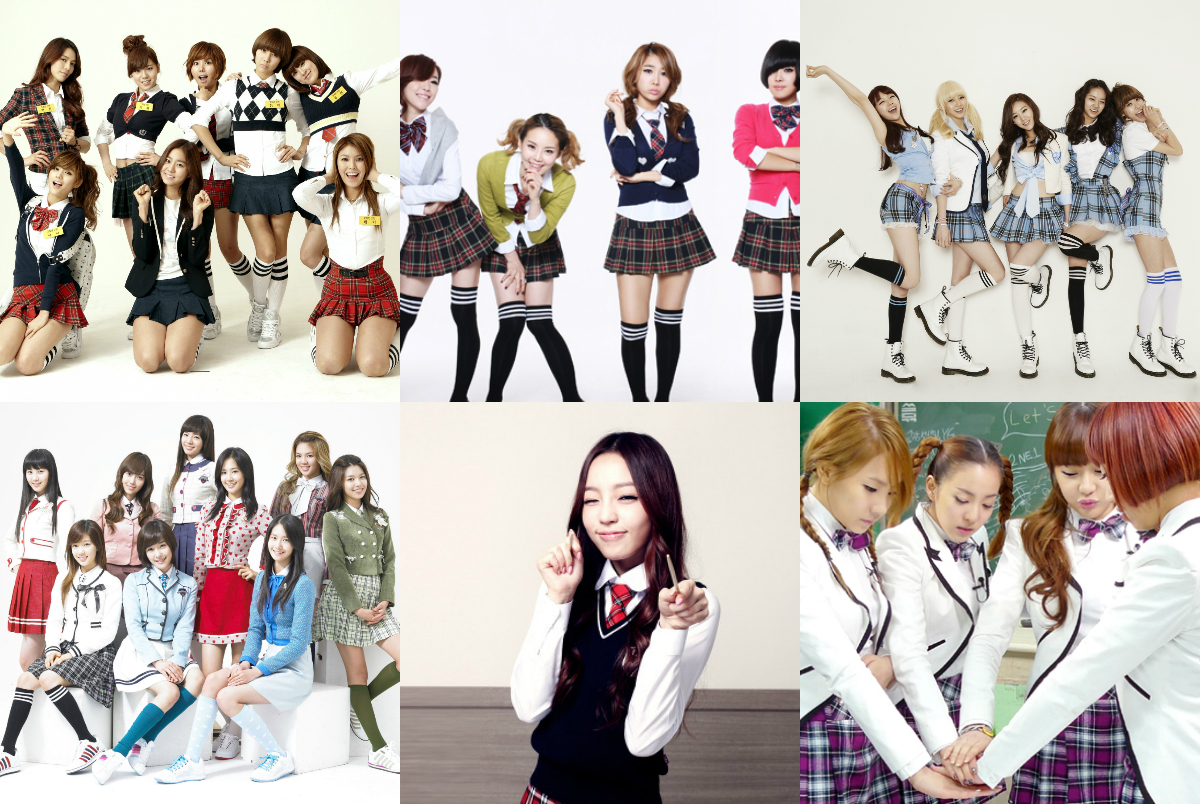
If you weren’t aware, I went to an all-girl Catholic high school. Yes, many many MANY years ago I actually WAS what so many girl bands have pretended to be and what an entire genre of fantasizers dream of: a plaid be-skirted school girl. My time was even before Katie Holmes graced the halls, so I have a long view on what I’m about to discuss.

Misc K-Pop artists, Taken from Timmdee’s article The Not-So-Innocent Side of the “Innocent” K-Pop Girl Group Look.
I had many opportunities in high school to take on a variety of roles and challenges- both academic and otherwise. The school managed to provide a fairly diverse community that allowed the students to begin developing into their own selves before sending us off into the wider world. I remember some teachers who challenged me to think critically, speak clearly and act decisively in whatever it was that I believed in. I thank them for their efforts. Even the people and things that bothered me at the time taught me something in the long run. The uniforms we wore made life a bit more simple and allowed us students the opportunity to weigh our daily accomplishments more on real merit than whether or not we “looked good” doing it. I had an amazing high school experience and it has definitely positively influenced my life to this very day. Some ways in the exact opposite direction that my parents probably intended when they first enrolled me, but that’s a tale for another day.

It wasn’t until well after I graduated that I discovered how close this adult-to-schoolgirl interest had been existing alongside my life back then and only in recent years how worldwide this phenomenon has become. Yes, men way older than should be looking really do like those uniforms. I would recommend that anyone NOT in a school with uniforms really reconsider donning the look to appeal to this particular interest.

As Timmdee points out in his Soompi.com article, “sexy” is fine and everywhere- male, female or anywhere else along the spectrum. It’s an essential part of adult lives. However, when someone tailors their demeanor or speech to appeal to a notion that puts themselves or another in an inferior relative position, that’s when the trouble begins. It propagates destructive stereotypes. It negatively affects everyone involved: adults, any children on the sidelines and all those teenagers.  All of them. Girls in school skirts are just plain sexy? Why can’t girls wear school skirts (or pants or whatever) simply to show the world they are going to a tough school? At this point, it’s perhaps easier to get rid of the school uniforms than to change the societal view but would it solve the actual issue?

When women decide to assume roles like this they take away from their own real merits: intelligence, humor, athleticism, artistic abilities and hard-earned maturity. It’s hard to say no to, but it’s an important effort. This essay dovetails with a previous essay of mine (The Word Soup We’re Living In) on using words that work to keep us all on a level playing field with each other. Here, I’m advocating the same balance on what we do. The future daughters of the women of today may face even more intense challenges because of the choices made today. We have the power to make other, more positive, statements for a better future.

Kids and teens need to try out new things: ideas, interests, clothing, jobs, etc. Teens are watching and trying things out for themselves (as they should) as they stand at the doorway to adulthood. Adults should be there as guides, challengers and supporters. They should not be participants in a system that by definition puts one member in a belittled, vulnerable position.

To all women today: I encourage you to work daily to express all the amazingly positive qualities women possess. I am encouraged by new networking sprouting up today, like 500womenscientists.org. Show your physical, mental and spiritual strengths to the world in ways that inspire those younger than you, impress those who are equal to you, and amaze those older than you.

Let’s show the world what we can all be- truly respectful of ourselves and of others regardless of gender.

Sunday, January 22, 2017

The Word Soup We're Living In


Serious: this essay isn’t rated G.


I love, love, LOVE words! I think there’s a word or turn of phrase to to describe or make ANY situation better. Smash your fingers in the car door? Yup- I have several really good ones for that. A kid figuring out a math problem they’ve been struggling with FOREVER? Oh yeah, I’m right there narrating the pleasure and exultation with glee.


So it really pains me to have a dislike for any words. I’ve been struggling a lot with this concept lately. My middle school son is coming home regularly with tales he’s heard and quotes of what he’s been called that are taking my already wild hairstyle to all new levels of crazy.


At first, I thought I might be just getting old and just needed to chill. Perhaps I was simply too old-fashioned to think it was harmful for 11 to 14 year old boys telling other boys to suck someone else’s d*** or that they are “<insert colorful adjectives of your choice> bitches” or <rhymes with punts> . This language seems to float in and out all day, every day.


I received assurances that yes, our language naturally changes all the time, in a great article by Betty Birner, PhD of Northern Illinois University. As Dr. Birner points out on the Linguistic Society of America website, “Language will never stop changing; it will continue to respond to the needs of the people who use it. So the next time you hear a new phrase that grates on your ears, remember that like everything else in nature, the English language is a work in progress.”


That lead me to ponder the needs these students are experiencing. Our words help us deal with life. What needs are these words meeting for those alive today?


While it’s definitely not the most “grating” term  (that adjective doesn’t even begin to describe my reaction to some of the words my son has shared with me this year), I decided to focus on the word “bitch” to examine this idea of need large-scale. Arielle Pardes wrote a marvelous piece, The Evolution of the Bitch, in Vice in 2014 that gives a comprehensive review of the term’s evolution in meaning from its birth in the 15th century to the present. Some people argue that words like this have lost their negative connotations- that they can actually be terms of endearment. I agree with Ms. Pardes, however, when she writes that the term “bitch” still relates to relative power: women with “too much” power are considered bitches. She continues with a remark on the reverse: “But when men aren't asserting enough power, they're called bitches too.” The word is still clearly double-edged. In my mind, it’s because we’re still not living in a world where every person is treated with respect and as equal.


Back to those middle school kids and their needs. I think they are attempting to assert their dominance and power. I think they are trying to self-protect via any means available to them. Those means include learning this sort of stuff via a multitude of sources-  probably both electronic and through their more immediate surroundings.


Why be concerned? Soaked into their everyday lives, the weight of these words will color their relationships from here on out. I believe this is showing up in our culture already. In Wisconsin, Aurora Health Care is investing millions of dollars through their Better Together Fund to assist colleges and their students deal with and prevent assault. Carroll University is using some of their funding to help teach male students how to demonstrate “healthy masculinity”. Are the mouths they had as pre-teens at least partially responsible for displays of “nonhealthy” masculinity in their late teens and early 20s?


I wholeheartedly encourage everyone to explore tough topics: politics, race, love, hate, war, peace, pleasure, depression, growing up/old and dying. Explore these themes in writing, vlogs, music, video games- everywhere. However, let’s use the entire depth and breadth of the world’s many beautiful languages. We all have something to say. We should all feel like we can say it and get our points across without it being at the expense of someone else. Let’s do all this eye-to-eye, not looking down at the other.


It’s going to take quite a bit of work to get there- but I think the goal is achievable and also of great importance. For the 11 to 14 year olds to come and beyond.


Addendum to those interested/involved in K-Pop:


The desire to shock and stand out are also at least partially responsible for the heavy presence of these words in the entertainment industries. I’m from the US music market but I have a personal interest in the K-Pop scene as it has historically offered a product that is fun, energetic and not reliant upon the types of misogynistic or violent themes other music genres have explored. I sincerely hope the artists in K-Pop think long and hard before emulating the rougher terms and behaviors just to sell something. Never say something or do something just because you think it’ll get you fame or to fit in somewhere.

I’d also like to propose that someone in the K-Pop industry, if they are looking to make further advances into the US market, look into connecting with some schools within the US to offer an Asian Studies program with K-Pop as a portion of the curriculum. Many students love the musical style already and the schools will be able to get behind a vast majority of the available content. Imagine what connections could be made between the two cultures! There is a hunger out there to learn about other people and their music. I’d love to help make this happen. If you agree, please comment or DM me.

Sunday, January 8, 2017

Support the Real You


Authentic adjective: true to one's own personality, spirit, or character


This word is tossed about quite a bit as our goal for our experiences, food, friends, and overall lives. We want them all to be “authentic”.

With the world at our fingertips, we can (unless someone tries to trick us) find truth with a few taps on a screen. We can also lose ourselves in increasingly realistic digital worlds that feel true. We *are* the rogue or paladin. We *are* going to take that sniper down. We can try on new television and music genres and find favorites from around the world (I’m looking at you, Goblin and BTS).

Which of these things is authentic?

I believe that, except for the intentional deceiver, they can all be authentic. Legitimate journalism uncovers facts. In a video game, we all know the rules and expectations. When this middle-aged woman is jamming to k-pop while going about her day, I’m truly enjoying the moods and melodies created by the artists.

It’s all authentic- true to one’s own personality, spirit or character.

I think the factor that removes all hopes of authenticity is negative intention. There can be no truth with that fly in the ointment. If your actions are performed with the intention to deceive yourself and/or others, everyone is robbed of authenticity.

It all becomes a lie.

So, let’s be authentic and see where it takes us. Whatever speaks to you, acknowledge it and what it is doing for you. If it scares you a bit, all the better. Being uncomfortable allows us to grow.

As for me, I have a confession. That BTS link goes to their 2017 Wings concert schedule, which is sold out. The Chicago date in March? Thanks to a certain someone, I’ll be there on the floor, authentically (and probably loudly and ridiculously) experiencing the spectacle- and I can hardly wait!!


Wednesday, November 30, 2016

Never Regret a Smile


I’m middle-aged and just now discovering what that might mean.

I’m not talking about wrinkles or stress or looming AARP mailers. I’m talking about regret. Why do we have stereotypes of freakouts during this time in our lives? If nothing more, it could be for the simple reason that our bodies are innately trying to do what we should be doing all along: regret nothing.

Sure, getting older means you know things. Your confidence grows as your experience lengthens. However, I’m becoming convinced that your middle-aged body's influx of energy is nature's way of trying, in a last-ditch effort perhaps, to get you back into a constructive mindset of growth and exploration: one based in joy, happiness and wonder.

If you can couple that mindset in a healthy way with the wisdom you’ve accrued, what revelations await? It doesn't have to simply result in a frivolous car purchase or destructive relationship choice.

Working as an assistant in an elementary school perhaps helped me begin to regain access to this more youthful perspective on the world where things are more fluid and potentials unchecked. Taking on the persona of a rogue in the classic MMORPG World of Warcraft back in my 30s, then diving into Japanese anime like Bleach and Attack on Titan and now enjoying Korean dramas such as this year’s Signal, W and Another Oh Hae-young and Korean pop like BTS’s I Need U- I've been reminded over and over to just loosen up and look at things differently. To not give in or up or simply endure but to enjoy what I'm doing and not regret it.

Basing your daily activities around the goal of simply experiencing them fully can make you truly appreciate all that you have right around you more intimately. It also reminds you that life is basically pretty good and can be made better by every one of your choices.

My biggest hope today is we all find a moment where we smile with pleasure and regret it not a whit.