Showing posts with label serendipity. Show all posts

Wednesday, October 11, 2017

100th Blog! The Power of I Don't Know


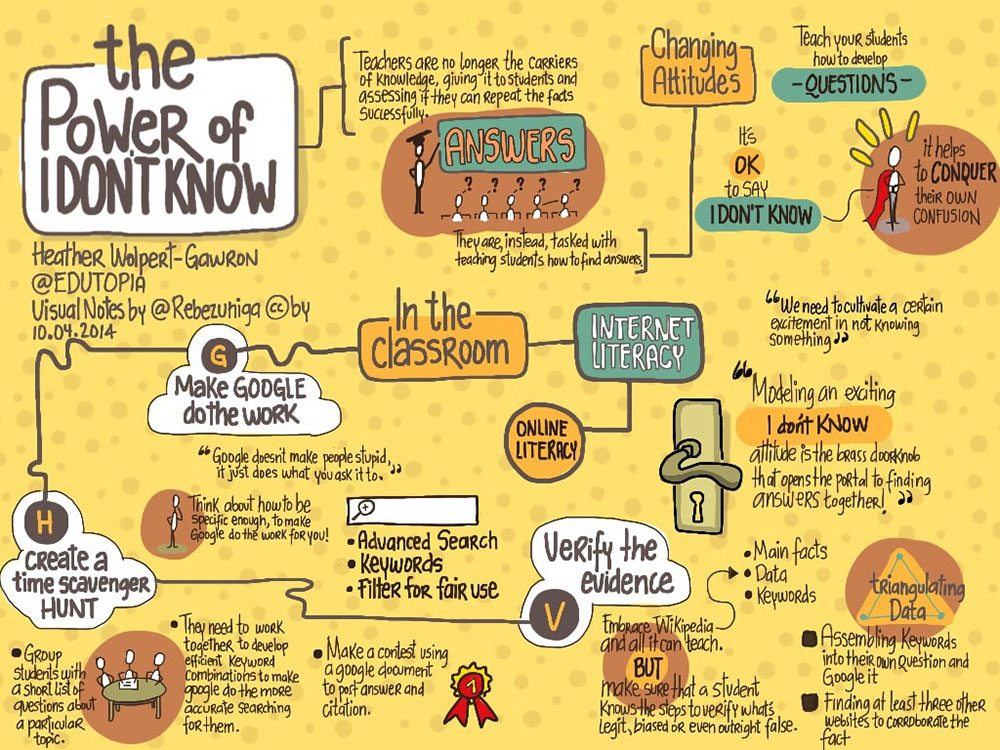
My younger son’s literacy teacher, Becky Anderson, shared this image with us when he was in the 4th grade. It popped up on my Facebook memories and struck me again for its applicability towards both young and old (and everything in between). Thanks to Heather Wolpert-Gawron and Rebeca Zuniga for their original inspiration from 2014! Many have responded to this graphic, including Terry Heick in a post on TeachThought. Today, I’m focusing on the truth that not knowing is a constant presence for us ALL and we should embrace it.


I didn’t know what to write about today. That’s OK.


I feel some pressure because it’s my 100th essay on Verbostratis! My first foray into this world was back in July 2016. Back then, I knew I wanted to push myself to begin and maintain a regular writing practice. I hoped I could do it, getting better as the days & weeks went by. That’s all I had.


I didn’t know what would happen. I was excited by that.


My first essay, titled Hugs, was only 227 words long and appears to have only been viewed 7 times to date. LOL!  I didn’t even write it in Google Docs to save an original. No formatting. No pictures. Nothing but my mind and keyboard. They were heady days of fear and amped up energy of hopeful aspiration.


I worried I would run out of things to say or that my ideas would be flat. I had to reach out to others.


I setup my blog. I dove into Twitter. I sent letters and emails. I met with people face-to-face. When I’m out in public, I talk to people. I ask questions. I wrote of Serendipity- we can stumble on something at any moment. There is a world of ideas out there if we just open ourselves to it. An almost limitless world that I wanted to add more to.


A blog didn’t seem enough. I looked at my goals and changed my plans by considering a book.


I’d always had vague visions of becoming an author. A number of unfinished works of fiction that still sit in binders and computer files attest to that. I’d never considered writing personal narratives or persuasive pieces. However, the powerful messages that aggressively condensed, stand-alone essays can convey became too much to ignore.


Again, reaching out to others helped me. I began learning how to self-publish, using CreateSpace. I wrote and Marlene Oswald’s photos proved just the thing to augment my words and paint a more detailed picture of the support I wanted to offer to teachers. The editing help that others provided was invaluable to the overall product that Dear Teachers became.


What next? I don’t know. Yet.


In my essay about not knowing....yet, entitled Yearn, Embrace & Try, I took Barbara Gruener’s acronym and stretched its message a bit. We want students to be comfortable with growing. We don’t know- YET. “Yet” requires us to yearn for something, embrace the challenge it takes to get there and be willing to try for the goal anyway.


What’s good for kids should be good for us adults, too, if it’s real. If it’s right. If it’s what we really should be teaching them in the first place. I think it is. I think we can all benefit from “I Don’t Know” and “Yet”.


If we can't benefit from not knowing, why bother with anything?


I’d love to know your thoughts. What would you like to see me write about? What are you looking to accomplish? What haven’t you achieved yet? Comment and forward my blog to your friends to continue this conversation. Thank you for reading and I wish you all the best!

Sunday, September 24, 2017

I Heart Failure


Failure? Really? Don’t we want to gloss over that and talk about success??

Failure: (noun) lack of success; a falling short
Resilience: (noun) an ability to recover from or adjust easily to misfortune or change
(from: Merriam-Webster.com. Merriam-Webster, n.d. Web. 24 Sept. 2017.)

I have meant to write about failure for a few weeks. Then, I found a 2015 article from Ross Morrison McGill’s Teacher’s Toolkit on resilience, titled Resilience Assembly, reposted on Twitter. I thought the piece offered some great advice as well as funny (but effective) visual tools. I especially loved Tom Sherrington's caricatures of student-types. I could see that it would all make great tie-ins to my main topic of failure.

My abs are really hurting me as I sit here typing this. I blame the pain and my need to talk about failure on Ben Booker and his Live to Fail workouts. Blame and thank.

More people are starting to embrace the need to fail. Ben takes it as a requirement to living. What does that really mean?

I wrote a bit about how this relates in education in my blog post Serendipity, where we ended up with the statement: Sometimes you win and sometimes you learn, but either way, you cannot lose.

The old word “lose” is moved in that action statement. You win or learn. You only lose when you do nothing. You have to bounce back. Be resilient.

Quoting Teacher’s Toolkit, 10 phrases to teach or promote resilience are:

  1. “Come on, laugh it off!”
  2. “Don’t let this spoil everything.”
  3. “Let’s take a break!”
  4. “Who have you spoken to about this?”
  5. “I know it looks bad now but you will get through this.”
  6. “What can you learn from this so it doesn’t happen next time?”
  7. “Don’t worry – relax and see what happens!”
  8. “This isn’t the end of the world.”
  9. “You could be right. But have you thought about … ”
  10. “What can we do about this?”

Ben’s muscle-building routine demands you work a muscle until it fails- where both the mind and body can no longer respond. Muscle grows under such controlled stress. The same goes for us. If we have and cultivate resiliency, we can reach higher and higher levels of body, mind and spirit.

Each person can develop a different formula to keep going based on their personality type. As described in Resilience Assembly, teachers can use different encouragements according to the student that is struggling. “Let’s take a break!” “This isn’t the end of the world.” “What can we do about this?” “Don’t worry – relax and see what happens!”

Let’s remember to turn those encouragements on ourselves and demand them from others, as well. “You could be right. But have you thought about … ” “What can you learn from this so it doesn’t happen next time?” “Come on, laugh it off!” “Don’t let this spoil everything.”

Do some of those seem like they wouldn’t work in the adult world? If they do, we’re not doing enough to embrace the need for, or impossibility of avoiding, failure. If we can’t apply these sentences to our everyday world, from personal to professional and on to societal, we’ll not reach out as far as we could. We’ll try to protect ourselves to the exclusion of real growth and change.

I titled this essay “I Heart Failure”. Despite myself wanting it to be different:

I see that failure is at the heart of everything.

I’d love to be perfect. I’d love to never screw up. But the only way for that to happen is if I just stop doing anything. That’s not really living. By embracing failure, our hearts can grow. We can experience more. We can do more. We can be more.

Together.

Saturday, August 19, 2017

Serendipity


Serendipity: (noun) the faculty or phenomenon of finding valuable or agreeable things not sought for


I decided to take a picture of one of my favorite t-shirts and post it on Twitter on Friday. It was a spontaneous decision and I’m glad I did.


My shirt came from TeeSpring and reads:


Mistakes Are Proof That You Are Learning


I love the mental space this message offers. It was sold as a math shirt, however I think it applies to quite a bit more. Like...everything. I’ve made mistakes in math, writing and science. I’ve also made some pretty epic ones at home and at work. With things. With people.


The very fact that we HAVE to make mistakes in order to grow has been a hard lesson for me to learn. I grew up with a nasty combination of both high expectations from outside and anxiety from inside. I suppose I posted the tweet to encourage others to embrace the strength of this message in a more timely fashion than me. That way of living is so painful and destructive.


What came after that post was the truly beautiful bit.


Two individuals stood up and responded. One from New Jersey (Jace @inspire0818). One from Georgia (Chris Shearer @hbprincipal). Between the two, something clicked in me. I found myself back in Wisconsin combining their thoughts into a brand new statement:


Sometimes you win and sometimes you learn, but either way, you cannot lose.


Then, Mr. Shearer took it up another notch and designed this cool graphic and shared it with us all. (As an aside, I can even see this as another t-shirt opportunity. I know I’d buy one.) Let’s dig a bit into this collaboratively-crafted sentence.


Sometimes You Win & Sometimes You Learn


There are times when we totally get it. There’s nothing better than feeling that wave of adrenaline when we achieve what we had hoped for and we can raise our arms up and howl in triumph. We’ve won! And yet, typically, we reach that AFTER we’ve failed. Whether it’s catastrophes or a simple series of minor hiccups, the victories come AFTER we learn from our mistakes.


Teachers remind students of this every day. We all could benefit from a voice gently whispering this reminder into our ears as we go about our days. “It’s OK! What worked? What didn’t? What can you do differently next time?”


Either Way, You Cannot Lose


When do we really lose? When we quit. When we lose hope. When we close ourselves off from people, from experiences and from the rest of the world. Initially, it may feel like we’re protecting ourselves. However, when we lock ourselves away from opportunities to win or learn, we in fact become adrift. Why? We don’t obtain the tools needed to captain our ships. Adrift, we are tossed about by the storms of fear, doubt, depression, and anger that brew for us all.


My experiences on Twitter over the last year have been amazingly uplifting. If you’re in education and aren’t active on it, you should check it out. You can find some fantastic peers and sources of inspiration. This was one of many beautiful connections. I’m encouraged to see what resources I can find as I continue my memoir/journal book for those with diabetes and begin writing another edition of Dear Teachers.

We’re all stronger #together. We’re all stronger when we win and when we learn #together. As long as we’re doing one or the other with positive intentions, we cannot lose.