Showing posts with label failure. Show all posts

Saturday, November 11, 2017

Great Expectations. Or Not?


An article came out this week that is getting quite a bit of attention in the education world. Goodbye Clip Charts, Marble Jars, and Stickers for Behavior was written by Kristine Mraz, an author and kindergarten teacher in New York City and member of The Educator Collaborative.


Behavior management systems.


Huh? If you’re not a teacher, you may never have stopped to consider how one adult orchestrates a large group of children (25-30 typically at a time, more as they get older and/or if districts cut back teacher positions) by his/herself all day AND gets stuff done. Things learned. Projects started. Full thoughts conveyed. How?


If you’re a parent, you know the temptation to bribe and coerce.

From Target.com


We’re entering that peak bribery and coercion time of year, in fact. “You better behave! Santa’s watching you!!” Here in Wisconsin, there’s yet another character employed to solicit compliance: Elf on the Shelf. This creepy elf (my personal opinion, granted) is WATCHING YOU.


This compliance approach has led to a variety of practices used today in many schools. Check Ms. Mraz’s article for specific details if you’re interested. For my purposes, I’d like to focus on our overall use of this in our culture, and see if I can tease out some more general problems we may all be familiar with and reveal some possible alternatives.


Bribery and coercion are effective in the short term.


Beyond the whole Santa thing, which obviously only lasts a month or two before you’re right back where you started (and perhaps worse off because the kids are coming down from a holiday free-for-all), we see bribery and coercion used in us adults. Rebates if you stop smoking or lose weight. A free month of gym membership if you sign up for a contract. Points for preferred customers.


We’re tempted to comply. It works for a while. We know we’re getting played, even as we comply. Many times, we slide back into our old ways. Or, we’ll pretend things have changed and we’ll hide the cigarettes and cupcakes.


Real change (growth) takes vested interest and a plan.


If I want to be healthier, if I want a specific job, if I want a relationship- I own that decision. To reach that goal, MY goal, I will find steps to get there. I need to understand what I can do and what I need to obtain. Training? Supplies? Expert advice? I will start the process and I will probably stumble. Repeatedly. If I’m really committed, I’ll step beyond myself and ask for teammates- family, friends or professionals- to work with me closely. They will help hold me to my plans and support me mentally and physically. I will practice and perhaps revise my plans and then try again.


When I reach my goal, I will feel that success deep in my bones. I’ll be grateful to all those who helped me. If I don’t succeed, I’ll still feel that gratitude and I’ll know that I tried as hard as I could. I will feel good for those 2 facts. My failure may eventually give me ideas that will lead to a future success or others may see my successes and failures and be inspired in their own journeys.


How do I become an adult who will do all that work?


I need to learn how to define what I want. I need to learn how to commit and to hope. I need to learn how to work with people. I need to learn how to pick myself up when I fall. I need to learn how to adapt. I need to learn how to ask for help. I need to learn that we all make mistakes and that’s just a part of life and that something good can still arise from “failure”.


This line from Ms. Mraz’s essay spoke volumes to me:


“Who cares if kids can read at level Z in first grade if they grow up to be narcissists, seeking rewards for kindness and masking shame behind bravado and cruelty?”


How do I become an adult who will do all that work? It’s by learning about and practicing those “I need to learn” skills I just outlined. At home. At school. At work. Practicing and living them every day. From birth. These are the things that teachers like Ms. Mraz are seeking to teach in their classrooms.


Is it necessary?


To answer that, I will leave you with these questions. Do you see many people today who seem rudderless, just looking for praise or fun? Do you see many people today who hide behind bravado and cruelty? Of those people you consider truly successful and positive, what traits do they embrace? The ones I indicated here and those advocated by Ms. Mraz and others, or the ones that are supported by bribery and coercion?


We all have a role in this, just as we all can play a role by changing our behaviors if our answers lead towards that call.

Sunday, September 24, 2017

I Heart Failure


Failure? Really? Don’t we want to gloss over that and talk about success??

Failure: (noun) lack of success; a falling short
Resilience: (noun) an ability to recover from or adjust easily to misfortune or change
(from: Merriam-Webster.com. Merriam-Webster, n.d. Web. 24 Sept. 2017.)

I have meant to write about failure for a few weeks. Then, I found a 2015 article from Ross Morrison McGill’s Teacher’s Toolkit on resilience, titled Resilience Assembly, reposted on Twitter. I thought the piece offered some great advice as well as funny (but effective) visual tools. I especially loved Tom Sherrington's caricatures of student-types. I could see that it would all make great tie-ins to my main topic of failure.

My abs are really hurting me as I sit here typing this. I blame the pain and my need to talk about failure on Ben Booker and his Live to Fail workouts. Blame and thank.

More people are starting to embrace the need to fail. Ben takes it as a requirement to living. What does that really mean?

I wrote a bit about how this relates in education in my blog post Serendipity, where we ended up with the statement: Sometimes you win and sometimes you learn, but either way, you cannot lose.

The old word “lose” is moved in that action statement. You win or learn. You only lose when you do nothing. You have to bounce back. Be resilient.

Quoting Teacher’s Toolkit, 10 phrases to teach or promote resilience are:

  1. “Come on, laugh it off!”
  2. “Don’t let this spoil everything.”
  3. “Let’s take a break!”
  4. “Who have you spoken to about this?”
  5. “I know it looks bad now but you will get through this.”
  6. “What can you learn from this so it doesn’t happen next time?”
  7. “Don’t worry – relax and see what happens!”
  8. “This isn’t the end of the world.”
  9. “You could be right. But have you thought about … ”
  10. “What can we do about this?”

Ben’s muscle-building routine demands you work a muscle until it fails- where both the mind and body can no longer respond. Muscle grows under such controlled stress. The same goes for us. If we have and cultivate resiliency, we can reach higher and higher levels of body, mind and spirit.

Each person can develop a different formula to keep going based on their personality type. As described in Resilience Assembly, teachers can use different encouragements according to the student that is struggling. “Let’s take a break!” “This isn’t the end of the world.” “What can we do about this?” “Don’t worry – relax and see what happens!”

Let’s remember to turn those encouragements on ourselves and demand them from others, as well. “You could be right. But have you thought about … ” “What can you learn from this so it doesn’t happen next time?” “Come on, laugh it off!” “Don’t let this spoil everything.”

Do some of those seem like they wouldn’t work in the adult world? If they do, we’re not doing enough to embrace the need for, or impossibility of avoiding, failure. If we can’t apply these sentences to our everyday world, from personal to professional and on to societal, we’ll not reach out as far as we could. We’ll try to protect ourselves to the exclusion of real growth and change.

I titled this essay “I Heart Failure”. Despite myself wanting it to be different:

I see that failure is at the heart of everything.

I’d love to be perfect. I’d love to never screw up. But the only way for that to happen is if I just stop doing anything. That’s not really living. By embracing failure, our hearts can grow. We can experience more. We can do more. We can be more.

Together.

Sunday, September 3, 2017

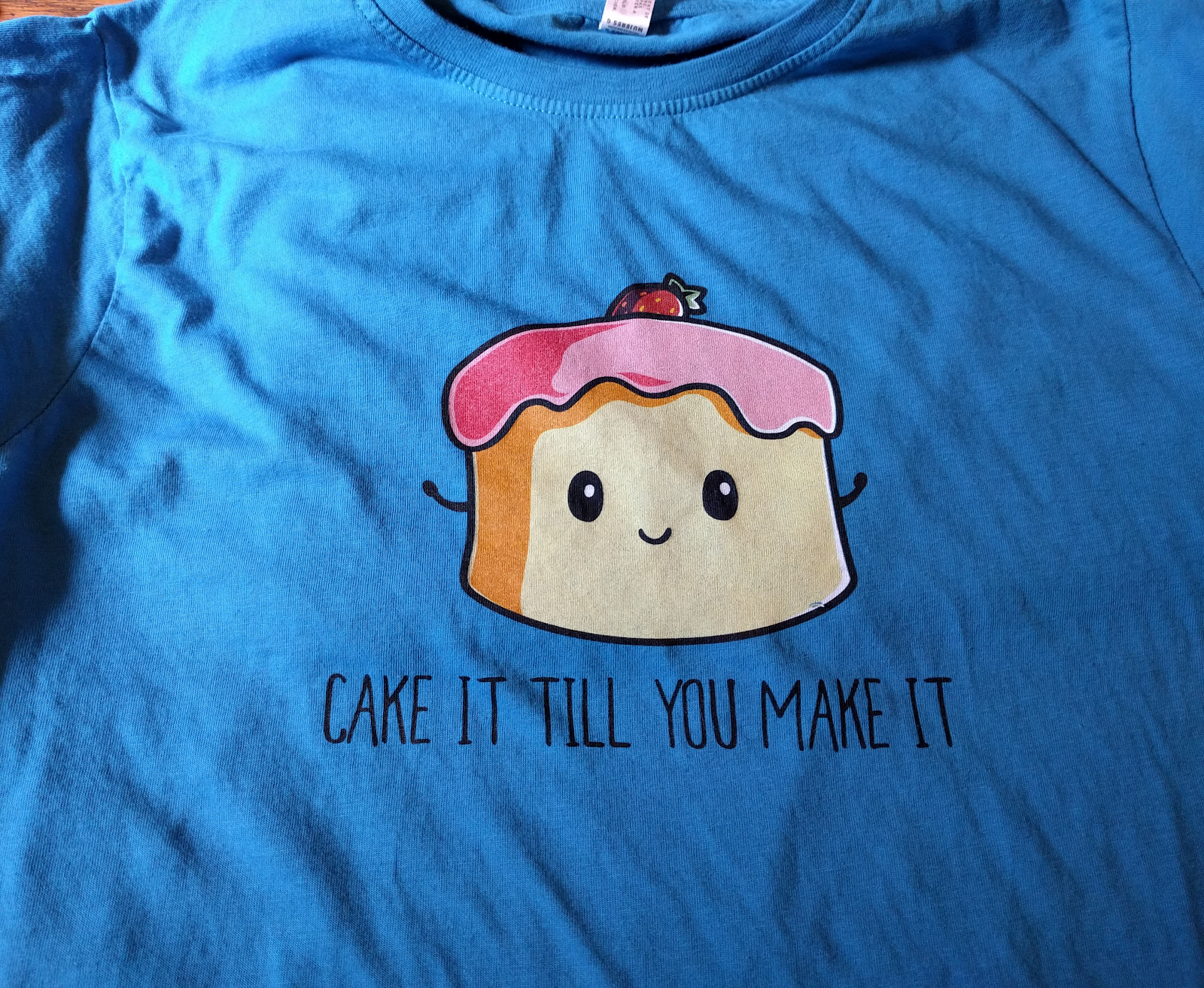
Cake It Till You Make It


Another shipment from TeeTurtle graced our front doorstep for the back-to-school shopping this year. I had to splurge on this one for myself. I’ve caked it. A lot.

I’m an introvert who gave myself rashes as a kid from anxiety over people's expectations. Now, having caked it for years, I walk around in public places seeking eye contact and smiles from strangers. I can stand in front of 10s or 100s and speak clearly. Even amusingly, upon occasion. I’ve caked myself there.

Every actor makes a living caking it. If we immerse ourselves in a role, we can harmonize with it and project it.

I took up singing as a junior in high school. I was terrified. I’d never sang in public. By senior year, I was in a song and dance group. I caked it into a group competition. If I were in high school today, it would be a completely different song set (can we say BTS covers like X.East?), but I would do it again in a heartbeat. That was an amazingly fun cake.

Will I ever become completely comfortable doing some of these things? Probably not. There are times when I absolutely cannot get my mind into the steps required in putting on a good cake. I need to retreat to peace, quiet and solitude. While being in the public eye is exhilarating, for me it is also absolutely exhausting and even painful at times.

Why do it, if it’s uncomfortable? With the pains, you learn things and meet people who help you grow. You see change and can feel pride in achieving something new.

Alas, the “make it” part can be temporary and elusive. But it can become more and more natural over time. While I can don the label of “confident writer” more comfortably now than I ever have, it is not a given in my mind. There are days and even weeks where I doubt everything I’m doing. I sometimes make a bad cake. It all crumbles and I’m left with a pile of bits, wondering what was I thinking and how could I hope to ever do anything that’s successful or worthwhile at all. I must go back to the kitchen to try again.

Despite that, caking it leads to sweet rewards. Caking it leads to things we can hardly imagine. We may not be able to reach a 5-tier confection with edible glitter and fresh fruit filling, but we can reach something truly delicious. Because it will be of our efforts. Because it will be of our hopes and dreams.

Because it will be us.

Tuesday, April 18, 2017

Self-Directed Living

Students directing their own learning.

We hear about it and talk about it all the time. We plan our days around it. We extol the virtues compared to the days of row-seating and podium-centered classrooms because of its amazing benefits in learning and growth.

What kind of people will our youth end up being and what sorts of experiences will they have over their lifetimes as they are steeped in this mindset from an early age? In my mind, the effects will be both enormously positive and difficult to bear upon occasion.

Until recent decades, our educational culture revolved around an indoctrination system of key tenants (reading, writing, math, etc) until one began to physically mature into adulthood. At that point, large segments moved on to trades and a wide range of employments while others moved on to college, where the remaining individuals were set free to explore the vastness and diversity of thoughts in arts, sciences, mathematics and engineering.  I’m not saying that pre-secondary educational programs were 100% spoon-feeding operations. My own public and private experiences going back to the 1970s included room for creativity and self-expression. The homemade Middle Ages serf costume I created in 6th grade, complete with rags on my feet, is basic evidence of this.

We’ve ramped it up quite a bit since then, however. Earlier and earlier we’re directing our children to spend their days exploring subjects that interest them. Wider and wider is the world view becoming. Students are gaining freedom to design, build and produce products from their own research and their own brains.

It’s heady stuff! I felt compelled to note some of my own thoughts, fears and experiences.

Accelerated Evolution and Divergence of Life Philosophies

Great though it can be, diversity of thought can separate us from those who surround us the most intimately. We’ve always had separations within classrooms and grade levels based upon common interests and goals. It’s easier for this to occur now and it naturally carries over more into home life. There are adults today who voice concerns on how things are being done. Sometimes it’s simply confusion. Other times, there’s an element of disgruntled “That’s not how we did it.” all the way to “I’m not comfortable with my child doing this.”. What excites a child’s mind may not mesh with the traditions and practices of the family, leading to fractures and conflicts. We need to remember this as we move through our interactions with students and the wider society.

On the opposite side, children also have new today to connect with others they would not have had access to in prior times. Therefore, the child with a fascination with the violin or anime can find someone to talk to either in school or online. These connections based on shared interests can bolster a nascent interest and belief in self. “I’m weird.” becomes “I’m not alone.”.

If students are to lead their own learning, we need a framework big enough to catch as many students as possible within a net of safety, support and hope. They will be the leaders of this system soon and by setting them up as best we can, our future is more sure to be successful.

Larger Potentialities for Both Personal Failure and Success

There was a time when you grew up knowing how your work life would turn out. Children mirrored their parents’ roles to a large degree, with small improvements that led to slow-paced advancement in each generation’s means. Families had professions (farming, dentistry, factory jobs, small businesses) that were taken up and passed down to the next generation.

Today, we press for students to decide. We give them as wide a spectrum of options as we can so they can decide what directions they wish to fly. Students from humble beginnings can rise on their drive, creativity and initiative to levels unheard of in their family histories.

However, there is a real fear in our youth and our older workers, that this is a faulty, dangerous dream. Companies and workers no longer hold each other in such high respect that a long-term social contract can be drawn. Opportunities seem held for those with connections, not inventive concepts worthy of investment. Advanced degrees are demanded for even the most basic of positions, further distancing those who stumble or who have minimal means, to being able to flower into self-sufficient members of society.

Anxiety runs high in our world today. We would be wise to discuss this and work with it. How do we ensure that the exploration will lead to a life that can be lived and not one that is lost?

Closer to Star Trek Federation or Annihilation

I confess that I religiously watched Star Trek The Next Generation while in high school and college. I loved the concept of all sorts of beings working together for common benefits and exploring the universe. I could never see how it could actually ever happen in real life, however. The Earth back in the years when this show aired, 1987-1994, was so mired in fears and hostilities between countries, we all feared for this single rock, let alone the cosmos.

This was before the digital age we live in today, where I can chat with someone in South Korea or London instantaneously. We can relate so easily. Students today converse and study together across town, across country and increasingly, around the world. It’s unbelievably exciting. Student-led learning can build bridges which might help make dreams like those Gene Roddenberry had, someday and in some fashion, become a reality.

Unfortunately, the spread of hate and exclusion can move just as fast as the speed of friendship and sharing. Schools need to give time and tools towards concepts of inclusion, how to resist hate and how to excise its power. Culture as a whole needs to pay attention to this. With so much power available, hate and hostility cannot just be left alone to wander where they wish. It could destroy all we hope and work for.

In Hope-filled Summary

We live in a time with more potential than any other. The risks and rewards are equally higher. We can do this. It takes never-ending hope, flexibly working together and always going back to who we’re doing this for in the first place: our children and the future.