Showing posts with label Krista Tippett. Show all posts

Sunday, April 29, 2018

Spring and the Death of Denial


It was one of the first nice days of spring yesterday, sunny and dry. My intentions were to rake a section of my back yard clean of winter’s deaths and cut out the skeletons of last year’s perennials, to allow room for the new year’s growth. I decided to also listen to a recent episode of On Being, and picked Krista Tippett’s conversation with Zen priest angel Kyodo williams, entitled The World is our Field of Practice.

That decision took my morning to a whole other realm of clean-up and growth.

I’ve been participating in a book club on Twitter, #ClearTheAir, led by @ValeriaBrownEdu, covering Richard Rothstein’s detailed and therefore painful, history of the systemic ways, from federal to local, that segregation has been cultivated in the United States. The Color of Law has brought out a slew of emotions and responses from participants, including me. It leaves one slipping into despair about half-way through.

The first death of denial: Are we doomed or is there hope?

I was heartened when the On Being talk lead with this quote from Rev. williams:

“There is something dying in our society, in our culture, and there’s something dying in us individually. And what is dying, I think, is the willingness to be in denial. And that is extraordinary. It’s always been happening, and when it happens in enough of us, in a short enough period of time at the same time, then you have a tipping point, and the culture begins to shift. And then, what I feel like people are at now is, “No, no, bring it on. I have to face it — we have to face it.””

I’ve felt this occasionally in recent years. Little jolts. But I’ve also had some people, even close family, laugh at me when I’ve said, “I don’t know, I think there’s something out there brewing! I think something’s growing and we’re not going back!” There’s a huge amount of skepticism.

The second death of denial: Change versus transformation

Rev. williams goes on to say, 

“We cannot have a healed society, we cannot have change, we cannot have justice, if we do not reclaim and repair the human spirit.”

Repairing that human spirit involves work- work on radically evolving both our inner selves and the systems we use today, which oppress large numbers of people. Capitalism. Patriarchy. White supremacy. The work must be transformational and not just change, Rev. Williams points out. Change-only could lead to simply replacing one system that doesn’t see every person as a human with another kind.

A healed society will no longer deny the humanity of any member. This reminded me of some of the most moving and transformative thoughts I’ve heard from survivors of The Holocaust. It speaks of the concept of restorative justice. This is the hardest part of this message to accept.

At face value, it’s not something that someone who’s been suffering wants to hear. Whatever our cause is: skin color, health care, sex, sexual orientation, religion, environment etc. We want justice. We embrace the “angry activist” lifestyle to change things. That can become a trap, too. That activist mindset does move us forward- it shakes things up. From that mindset, however, another group soon loses their human spirit and humanity. We also need to step beyond activism, to being open to the idea that everything and everyone is incomplete and suffering. That relates to grace.

Spring: Grace and fearlessness

Rev. williams described how the reaction of a person looking at the history of race in the United States should be one of: 

“”How extraordinary that black people, in particular — indigenous people, as well — could live the lives of dignity that they have chosen for themselves in the face of the onslaught of what this country’s history has been and continues to be and continues to put upon them.” So grace, I think, is a gift that black peoples have inhabited for a great deal of time.”

People rise above retribution. When I think of all the groups who have been targets of abuse by controlling organizations of people, both here and elsewhere around the globe, it’s something that leaves me in wonder and awe of the human spirit. That positive energy does not die out completely. It survives with fearless determination to bloom when it senses spring.

Rev. williams embraces the idea of fearlessness and believes it is a bold statement of defiance, saying people of African descent are expected to not be fearless. To be scared. The concrete evidence in The Color of Law confirms that. Fear, to me, is the big tool used by aggressors on both their targets and anyone who might step in to become allies of those targets. The bully, the victim and those on the sidelines. The bully relies on believing everyone else is “Other” and lacks a connection to them in the human spirit. If we decide to stay within our own protective barricades because of fear, I think we do lose it. We’re less human when we decide to simply save ourselves. Coming together makes us more.

This conversation was invigorating, like the fresh spring breezes and the sweat I felt as I worked. It cleansed me and planted fresh ideas to explore. I can’t do this conversation full justice here on this blog- I highly recommend listening to it in its entirely and simply seeing how it speaks to you and your experiences.


Reverend angel Kyodo williams is the founder of the Center for Transformative Change in Berkeley, California. She’s the author of Being Black: Zen and the Art of Living With Fearlessness and Grace and Radical Dharma: Talking Race, Love, and Liberation.

Thursday, January 4, 2018

Living in Now: 6 Actions of Gratitude


Gratitude seeks to be expressed to those who inspire.

At the end of my book, Dear Teachers, I listed a few people who have electrified my mind over the years. Krista Tippett is one of those people, and I was reminded this week of her influence when I listened to her December 21, 2017 podcast of a 2016 conversation she had with David Steindl-Rast, called Anatomy of Gratitude.

Brother David was born in Austria in 1926, and has lived a life that’s taught him the importance of living with gratitude. It’s a fantastic interview that I encourage you to check out. In addition, I’d like to list a few connections I see between what he talked about and the overall theme of my January book essays, summed up in the illustration: sometimes we need to GO. This theme applies to all of us.

Gratitude demands awareness of what we have.


To experience gratitude, we must be grateful: appreciative of benefits received, according to Merriam-Webster.. I wrote in Hustle When It’s Time, “There are times we should GO.” We plan ahead so much. We lose track of so much. What we have right now is very precious. It takes effort and attention to see and feel it.

Gratitude cultivates joy, which can be a long term state.

As Brother David described it, the awareness of all that we have, not what we lack or want, can allow us the pleasurable sensation of joy. This is different than happiness, comes and goes with each new acquisition or quest. Joy can be a state of being where we can see that Life is tough, but the gratitude we feel sustains us and gives us hope.

In my own writing, I described that joy, in A Time to Unfurl, as being in the right place, which allows one’s beauty to unfurl like the petals on a flower.

Gratitude gives us the strength to squeeze through the anxiety of change in order to grow.


I loved Brother David’s story of how our birth is our first experience of anxiety. His sense of the term “anxiety” is not the typical helpless one we many times think of today. To him, we feel anxiety when we’re on the edge of growing into something bigger. It’s uncomfortable and scary. However, if we GO, we’ll grow and blossom. If we STAY, if we can’t get beyond the fear, we stagnate and die.

I wrote of this in my essay, Embracing the Storm. “There will be storms. After they pass, we can see the light break through the clouds together.” That last word brings me to my next point.

Gratitude leads to connections with others, which will be our strength.

We’ve all had experiences (hopefully!) where someone has told us, “You can do this! It’ll be great!”. That person sees potential and wants to share their joy. We've also all rooted someone on (again, hopefully!) in that manner ourselves. When we are aware of our gifts, we want to share that feeling and those gifts with others.

Brother David mentioned a quote from Raimundo Pannikar which summed this up beautifully: 


“The future will not be a new, big tower of power. Our hope in the future is…well-trodden paths from house to house. That is the image that holds a lot of promise for our future.”


We grow as individuals and as a whole society when we share with each other on a regular basis. It doesn’t happen when we lock ourselves away. It doesn’t happen when we wait or worry constantly, and we absolutely must come together so that we can give and receive the next action of gratitude.

Gratitude is active availing ourselves of the moment's opportunity.

That was one of Brother David’s last thoughts and brings me back to my own on our need to GO. We get opportunities. We make opportunities for others. When we are filled and living with gratitude, we can give and receive more and more, in larger and larger circles.

That’s a key for success for us all.


Need help practicing gratitude? Check out Unstuck's 9 suggestions here!

Friday, April 28, 2017

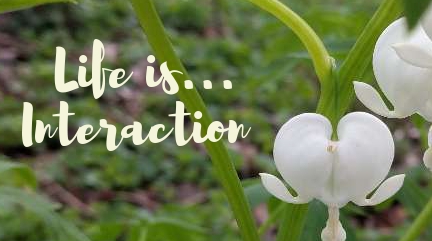
Life Is Interaction

Life_is.jpg
On Being always has though-provoking podcasts. In my spring yard work craze this week, I was able to listen to Krista Tippett’s dialogue with Italian physicist Dr. Carlo Rovelli entitled All Reality is Interaction for the second time and it was even more rewarding than the first. I am anxious to read his book, Seven Brief Lessons on Physics, which they reviewed.


The very title of the discussion was a revelation to me. Dr. Rovelli’s assertion that life is not about things, it’s about interactions, made me pause to consider. At one level, it made me think of the old physics rules we learned in high school about energy moving from one form to another. We can picture everything as a dance and flow of energy. We expend and receive it all day long. To get to school, we use energy. When we talk, we’re converting calories to what fuels our brain, breathing and muscles.  When we reach out to pat a loved one’s shoulder, again, there’s energy conversion and interaction.


Then, he took it up another notch. He commented that we can either interact as warriors or as collaborators.


Talk about smacking me upside the head with simple truth. I had to set my branch clippers to the side for a minute  in order to sit with that idea for a bit.


Interaction is life. But WE choose HOW.


Why does this excite me?


Sometimes it feels like we’re stuck. Personally, I’ve had times where it’s seemed as though I wasn’t getting anywhere. Dr. Rovelli’s first assertion and proof establishes that life, by definition, is not static. It’s constantly moving. Even a rock, as he puts it, is a rock for only a while. It was in another state before it became a rock and it will decay into something else eventually. His words remind that there is always change, we just might not see it.


Sometimes the world feels excessively competitive and dangerous. From world leaders to us and the folks down the street, interactions can be weighted heavily towards “Me Versus You”. We can sit with “our” people on social media and separate ourselves a hundred different ways from “those people”.


Dr. Rovelli reminds us, using physics as his teaching prop, that the interaction of energy we experience doesn’t have to be that way. The idea that we’re all undergoing a constant flow of energy brings us together. With similar conditions placed upon us all, it makes sense to collaborate.


We should collaborate before we fight.


A kiss. A smile. A discussion. A birth. A death. A meal. A walk. We can’t hold any of these things in our desk drawer. They are interactions between us and everything and everyone around us. Dr. Rovelli’s thoughts challenged me to focus even more on building bridges and connections.


We can achieve so much more by holding hands than holding onto fears.